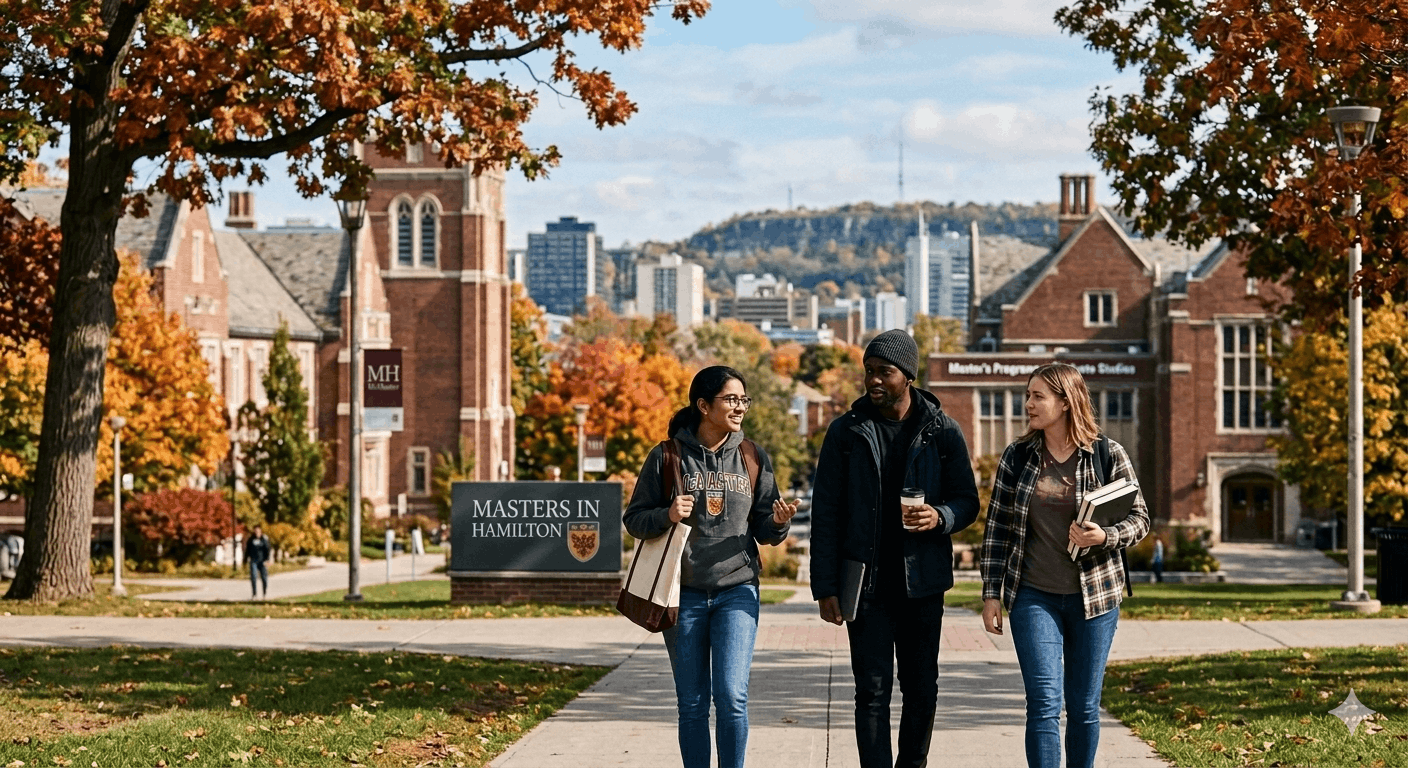
Masters in Hamilton
Table of Contents
- Why Study Masters in Hamilton?
- Top University in Hamilton for Masters
- Best Courses for Masters in Hamilton
- Eligibility and Admission Requirements for Masters in Hamilton
- Cost of Masters in Hamilton
- Scholarships and Funding for Masters in Hamilton
- Intakes and Application Timeline for Masters in Hamilton
- How to Apply for Masters in Hamilton
- Student Visa Requirements for Masters in Hamilton
- Work Opportunities While Studying Masters in Hamilton
- Career Opportunities After Masters in Hamilton
- Author's POV
A Masters in Hamilton gives international students the opportunity to study in a city known for its academic excellence, research opportunities, and strong graduate employment prospects. Whether you're interested in business, engineering, health sciences, data science, or the humanities, Hamilton offers a wide range of postgraduate programmes designed to meet global industry needs.
Home to internationally recognised universities and a growing innovation ecosystem, the city combines high-quality education with a welcoming student environment. From modern research facilities to valuable industry connections, pursuing a Masters in Hamilton can help you gain advanced skills, expand your professional network, and prepare for a successful international career.
Key Highlights of Masters in Hamilton:
Key Highlights | Details |
Primary University | McMaster University, Hamilton, Ontario, Canada |
QS World Ranking 2027 | #174 globally; #8 in Canada |
THE World Ranking 2026 | #116 globally |
Programme Duration | 1 to 2 years for most master's programmes |
Popular Fields | Health Sciences, Engineering, Business, Computer Science, Social Sciences, Kinesiology |
Tuition Fees (International PG) | CAD 17,096–63,347/year (approx. Rs. 10.6L–Rs. 39.3L/year) |
MBA Fees | CAD 107,300 total programme (approx. Rs. 66.5L total) |
Living Expenses | CAD 14,000–20,000/year (approx. Rs. 8.68L–Rs. 12.4L/year) |
Post-Study Work Option | Post-Graduation Work Permit (PGWP) up to 3 years |
Why Study Masters in Hamilton?
Choosing a Masters in Hamilton means getting the advantage of studying at a globally recognised university while living in a city that is more affordable and student-friendly than many larger Canadian destinations. Hamilton offers a strong mix of academic excellence, industry exposure, and quality of life, making it an attractive option for international students.
Why do students choose Hamilton for postgraduate study?
1. Study at a Globally Recognised University
Hamilton is home to McMaster University, one of Canada's leading research universities. Its strong reputation in health sciences, engineering, business, and research attracts students from around the world.
2. Lower Living Costs Compared to Toronto
Hamilton offers a more affordable lifestyle than Toronto while keeping students within easy reach of Ontario's largest employment hub. Lower accommodation and daily expenses can make a significant difference when managing the overall cost of a two-year master's programme.
3. Strong Industry and Research Connections
Graduate students benefit from McMaster's partnerships with healthcare organisations, businesses, government bodies, and research institutions. These connections create opportunities for research projects, internships, and career development.
4. A Learning Approach Focused on Real-World Problem Solving
McMaster is internationally known for its problem-based learning approach, where students work on practical challenges instead of relying only on traditional classroom learning. This helps graduates develop analytical thinking, teamwork, and decision-making skills valued by employers.
5. Growing Career Opportunities Across Industries
Hamilton has evolved from a traditional manufacturing city into a growing hub for healthcare, technology, advanced manufacturing, and innovation. This expansion has created more opportunities for graduates looking to build careers after completing their studies.
6. Easy Access to Toronto's Job Market
Hamilton's location in Ontario provides students with access to Toronto's extensive employment ecosystem while avoiding the higher living costs of Canada's largest city. This makes it easier to explore career opportunities across the Greater Toronto and Hamilton Area (GTHA).
7. A Student-Friendly City with a Strong Community
Beyond academics, Hamilton offers a welcoming environment with cultural attractions, green spaces, restaurants, and a diverse population. International students can enjoy a balanced lifestyle while adapting to life in Canada.
Top University in Hamilton for Masters
Unlike larger Canadian cities that have several major universities, Hamilton's postgraduate education landscape is largely shaped by one globally recognised institution: McMaster University. The university offers a wide range of master's programmes across engineering, business, health sciences, computer science, and research fields, making it the main choice for international students planning postgraduate study in Hamilton.
University | QS World University Ranking 2027 | Popular Master's Programmes |
McMaster University | #173 globally | Engineering, Computer Science, Business Administration, Public Health, Health Sciences, Data Science |
Best Courses for Masters in Hamilton
McMaster's strongest graduate programmes reflect both its research heritage and Hamilton's evolving economy. Health sciences, engineering, computer science, business, and social sciences are the fields where the university has built genuine depth and active employer connections.
1. Health Sciences and Medical Programmes
Health sciences at McMaster benefit from the university's world-renowned problem-based learning model and partnerships with Hamilton Health Sciences, one of the largest hospital networks in Canada. These programmes connect students directly to clinical research and practice environments.
McMaster is one of only four Canadian universities in the world's top 35 for medicine and health studies in QS subject rankings, which gives health sciences graduates from Hamilton a degree that carries genuine weight internationally.
Course | Duration | Approx. Annual Tuition (International) |
MSc Health Research Methodology | 2 years | CAD 17,096–25,000/year (approx. Rs. 10.6L–Rs. 15.5L/year) |
MSc Global Health | 2 years | CAD 17,096–25,000/year (approx. Rs. 10.6L–Rs. 15.5L/year) |
MSc Kinesiology | 2 years | CAD 17,096–22,000/year (approx. Rs. 10.6L–Rs. 13.6L/year) |
MSc Nursing | 2 years | CAD 17,096–22,000/year (approx. Rs. 10.6L–Rs. 13.6L/year) |
MHSc Occupational Therapy | 2 years | CAD 25,000–35,000/year (approx. Rs. 15.5L–Rs. 21.7L/year) |
2. Engineering and Computer Science Programmes
Engineering and computer science at McMaster sit within one of Canada's leading engineering faculties, with strong research groups in computing, software, materials, and chemical engineering. These programmes connect directly to Hamilton's Innovation District and Toronto's technology employment market.
McMaster's engineering and computing programmes carry STEM designation under Canadian immigration frameworks, which matters for international students planning to use the full post-graduation work authorisation window after completing their degree.
Course | Duration | Approx. Annual Tuition (International) |
MSc Computer Science | 2 years | CAD 13,500–18,000/year (approx. Rs. 8.37L–Rs. 11.16L/year) |
MEng Computing and Software | 1 to 2 years | CAD 17,325–22,000/year (approx. Rs. 10.74L–Rs. 13.64L/year) |
MEng Technology Entrepreneurship and Innovation | 20 months | CAD 15,015/year (approx. Rs. 9.31L/year) |
MASc Computational Science and Engineering | 2 years | CAD 8,548–15,000/year (approx. Rs. 5.3L–Rs. 9.3L/year) |
MASc Chemical Engineering | 2 years | CAD 8,548–15,000/year (approx. Rs. 5.3L–Rs. 9.3L/year) |
3. Business and MBA Programmes
Business at McMaster is centred in the DeGroote School of Business, which offers both the MBA and specialised master's programmes. The DeGroote MBA is particularly well regarded for its focus on leadership, data analytics, and health services management, which connects directly to Hamilton's dual identity as a health sciences and business hub.
Course | Duration | Approx. Annual Tuition (International) |
MBA (DeGroote) | 2 years | CAD 107,300 total programme (approx. Rs. 66.5L total) |
MSc Business Administration | 1 to 2 years | CAD 35,000–45,000/year (approx. Rs. 21.7L–Rs. 27.9L/year) |
MSc Finance | 1 year | CAD 40,000–55,000/year (approx. Rs. 24.8L–Rs. 34.1L/year) |
MSc Management of Innovation and New Technology | 1 to 2 years | CAD 35,000–45,000/year (approx. Rs. 21.7L–Rs. 27.9L/year) |
4. Social Sciences and Humanities Programmes
Social sciences at McMaster cover a broad range of disciplines from economics and psychology to social work and communication studies. These programmes are supported by active research centres and community partnerships across Hamilton and the broader Ontario region.
Course | Duration | Approx. Annual Tuition (International) |
MSc Psychology, Neuroscience and Behaviour | 2 years | CAD 17,096–22,000/year (approx. Rs. 10.6L–Rs. 13.6L/year) |
MA Sociology | 2 years | CAD 17,096–20,000/year (approx. Rs. 10.6L–Rs. 12.4L/year) |
MSc Economics | 2 years | CAD 17,096–22,000/year (approx. Rs. 10.6L–Rs. 13.6L/year) |
MSW Social Work | 2 years | CAD 17,096–25,000/year (approx. Rs. 10.6L–Rs. 15.5L/year) |
MA Communication and New Media | 2 years | CAD 17,096–20,000/year (approx. Rs. 10.6L–Rs. 12.4L/year) |
Eligibility and Admission Requirements for Masters in Hamilton
Admission to McMaster's graduate programmes is competitive and assessed across academic performance, research experience, language proficiency, and the quality of supporting documents. Requirements vary by programme and faculty but follow a broadly consistent framework.
Academic Requirements
A four-year undergraduate degree with a strong academic average is the standard requirement across most McMaster master's programmes. Health sciences and engineering programmes may have additional prerequisites in relevant subject areas.
Programme Area | Academic Requirements |
Health Sciences (MSc, MHSc) | Four-year bachelor's degree; minimum B plus average (77 percent); relevant science background preferred |
Engineering and Computer Science (MEng, MASc, MSc) | Four-year bachelor's degree in engineering or computer science; minimum B plus average |
Business (MBA, MSc) | Four-year bachelor's degree; minimum B average; work experience required for MBA |
Social Sciences and Humanities (MA, MSc) | Four-year bachelor's degree in relevant field; minimum B average; research experience valued |
English Language Requirements
International students from non-English speaking countries need to provide recognised English proficiency test scores. Some programmes may waive this requirement if the prior degree was completed entirely in English at a recognised institution.
Test | Minimum Requirement |
TOEFL iBT | 88 overall; no section below 20 |
IELTS Academic | 6.5 overall; no band below 6.0 |
PTE Academic | 60 overall |
CAEL | 70 overall |
Other Admission Requirements
Beyond grades and language scores, a competitive McMaster graduate application requires well-prepared supporting documents that demonstrate academic readiness, research potential, and career motivation specific to the chosen programme.
Document | What It Should Cover |
Statement of Interest | Research interests, career goals, and reasons for choosing the specific programme at McMaster |
Letters of Reference | Two to three academic or professional references who can speak to research potential and academic performance |
CV or Resume | Academic background, research experience, publications, work history, and relevant skills |
Transcripts | Official transcripts from all post-secondary institutions attended |
Research Proposal | Required for thesis-based programmes; outlines proposed research questions and methodology |
Supervisor Confirmation | Required for thesis-based research programmes before or at the point of application |
Cost of Masters in Hamilton
One of the genuinely practical advantages of choosing Hamilton for graduate study is the cost. Both tuition and living expenses at McMaster sit meaningfully below what students pay at Toronto or Vancouver universities for comparable programmes, which makes a real difference across a two-year master's budget.
Tuition Fees at McMaster University
Tuition fees at McMaster vary considerably by programme type and faculty. Research-based programmes like MASc and thesis-based MSc tend to be lower than professional programmes like MBA or some MEng tracks. Figures below reflect current international student rates from official McMaster sources.
Programme Type | Approx. Annual Tuition (International) | INR Value |
Research-Based MSc and MASc | CAD 8,548–17,096/year | Rs. 5.3L–Rs. 10.6L/year |
Professional Masters (MEng, MSc specialised) | CAD 15,000–35,000/year | Rs. 9.3L–Rs. 21.7L/year |
Business MSc and Management Programmes | CAD 35,000–63,347/year | Rs. 21.7L–Rs. 39.3L/year |
MBA (DeGroote School of Business) | CAD 107,300 total programme | Rs. 66.5L total programme |
Health Sciences Professional Masters | CAD 17,096–35,000/year | Rs. 10.6L–Rs. 21.7L/year |
Cost of Living in Hamilton for Masters Students
Hamilton is considerably more affordable than Toronto or Vancouver for students managing monthly expenses. The cost savings on accommodation alone can amount to several thousand dollars per year compared to studying in a major Canadian metro city.
Expense Category | Approx. Monthly Cost | INR Value |
Accommodation | CAD 700–1,200/month | Rs. 43,400–Rs. 74,400/month |
Food and Groceries | CAD 300–450/month | Rs. 18,600–Rs. 27,900/month |
Transport (HSR Student Pass) | CAD 80–100/month | Rs. 4,960–Rs. 6,200/month |
Health Insurance (UHIP) | CAD 756/year | Rs. 46,872/year |
Books and Personal Expenses | CAD 100–200/month | Rs. 6,200–Rs. 12,400/month |
Total Annual Living Cost | CAD 14,000–20,000/year | Rs. 8.68L–Rs. 12.4L/year |
Scholarships and Funding for Masters in Hamilton
McMaster offers substantial scholarship and funding opportunities for graduate students, and several external awards are also available for international students. Starting scholarship research at least 12 months before your intended intake gives the best results.
Scholarship or Award | Eligibility | Coverage |
McMaster Graduate Fellowships | All eligible graduate students; reviewed at admission | Varies by programme and faculty |
Ontario Graduate Scholarship | Enrolled in an Ontario university; strong academic merit; open to international students | CAD 10,000–15,000/year (approx. Rs. 6.2L–Rs. 9.3L) |
Vanier Canada Graduate Scholarships | Exceptional academic standing and leadership; nominated by Canadian university | CAD 50,000/year (approx. Rs. 31L) for up to 3 years |
McMaster Entrance Scholarships (UG level) | International undergraduate students; merit-based | CAD 7,500–210,000 (approx. Rs. 4.65L–Rs. 1.30Cr) |
Research Assistantships | Strong academic performance; tied to supervisor research grants | Stipend plus partial or full tuition; varies by supervisor and project |
Teaching Assistantships | Strong academic record; availability determined by department | Partial tuition plus hourly stipend |
Intakes and Application Timeline for Masters in Hamilton
McMaster University primarily offers a September intake for most master's programmes, with a limited January option for select programmes. Planning around McMaster's application deadlines and starting document preparation early makes the process considerably smoother.
Intake | Programme Start | Application Timeline |
September Intake (Main) | September | Most programme deadlines fall between December and April; check each programme individually |
January Intake (Limited) | January | Available at select programmes; applications open June to September |
May Intake (Limited) | May | Available at some programmes; check directly with the relevant faculty |
NOTE:
September is the primary and most practical entry point for Masters in Hamilton, offering the widest programme selection and strongest scholarship availability.
For thesis-based programmes, finding and confirming a supervisor before applying is critical and should happen several months before the formal application deadline.
Research-based admissions at McMaster are partially driven by supervisor availability and research funding, which makes early outreach to potential supervisors an important first step.
How to Apply for Masters in Hamilton
The application process at McMaster is straightforward but has some specific requirements, particularly the supervisor confirmation needed for research-based programmes, that students often underestimate in terms of how early they need to be addressed.
Step | What to Do |
Step 1: Research Programmes | Compare McMaster's graduate programmes by faculty, research area, and career direction |
Step 2: Contact Supervisors (Research Programmes) | Email potential supervisors with your CV and research interests before applying to thesis programmes |
Step 3: Check Eligibility | Review GPA requirements, language minimums, and programme-specific prerequisites |
Step 4: Prepare Language Tests | Sit TOEFL iBT or IELTS at least two to three months before application deadline |
Step 5: Compile Documents | Gather transcripts, statement of interest, two to three LORs, CV, and passport |
Step 6: Submit Application | Apply through the McMaster University graduate admissions portal; pay application fee |
Step 7: Apply for Scholarships | Submit scholarship applications alongside or immediately after admissions application |
Step 8: Accept Offer | Confirm place by accepting offer and paying enrolment deposit |
Step 9: Apply for Study Permit | Submit Canadian Study Permit via IRCC with offer letter and financial documentation |
Student Visa Requirements for Masters in Hamilton
International students admitted to McMaster need a Canadian Study Permit from IRCC before travelling. The process follows the same framework as all Canadian university Study Permits, and starting it as soon as the offer letter arrives is the most practical approach.
Requirement | Detail | Approx. Amount |
Offer Letter | From McMaster University confirming graduate programme admission | Required |
Proof of Financial Capacity | Tuition plus living costs for first year | CAD 20,635/year (approx. Rs. 12.79L) |
Study Permit Application Fee | Paid online via IRCC portal | CAD 150 (approx. Rs. 9,300) |
Biometrics Fee | Required for most international applicants including Indian students | CAD 85 (approx. Rs. 5,270) |
Medical Examination | Required for applicants from certain countries including India | Cost varies |
UHIP Health Insurance | University Health Insurance Plan; mandatory for McMaster international students | CAD 756/year (approx. Rs. 46,872/year) |
English Test Scores | TOEFL iBT 88 or IELTS 6.5 minimum | Programme-specific |
Academic Documents | Transcripts, degree certificates, test scores | Required |
Note: After completing their degree at McMaster, eligible graduates can apply for a Post-Graduation Work Permit giving up to three years of open work authorisation in Canada. McMaster is a Designated Learning Institution, meaning all eligible programme graduates qualify for the PGWP.
Work Opportunities While Studying Masters in Hamilton
International students with a valid Canadian Study Permit can work up to 20 hours per week during the academic term and full-time during scheduled university breaks. For graduate students at McMaster, research assistantships and teaching assistantships are the most common and directly relevant work arrangements.
Role | Work Limit | Approx. Earning |
Research Assistantship | Part of programme funding for thesis students | Stipend included in funding package; varies by supervisor |
Teaching Assistantship | Up to 10 hours/week typically | CAD 22–30/hour (approx. Rs. 1,364–Rs. 1,860/hour) |
On-Campus Support Roles | 20 hours/week during term | CAD 16–22/hour (approx. Rs. 992–Rs. 1,364/hour) |
Off-Campus Work (During breaks) | Full-time during scheduled breaks | CAD 16–22/hour (approx. Rs. 992–Rs. 1,364/hour) |
McMaster Work-Study | Financial need-based; on-campus positions | CAD 15–20/hour (approx. Rs. 930–Rs. 1,240/hour) |
Career Opportunities After Masters in Hamilton
Graduating from McMaster in Hamilton puts you within reach of Ontario's largest employment markets. Toronto is an hour away, Hamilton's own health sciences and technology sectors are growing actively, and the PGWP gives you three years to build Canadian work experience before considering longer-term options.
Job Role | Approx. Annual Salary (CAD) | INR Value |
Software Engineer | CAD 80,000–120,000 | Rs. 49.6L–Rs. 74.4L |
Health Research Analyst | CAD 65,000–95,000 | Rs. 40.3L–Rs. 58.9L |
Biomedical Engineer | CAD 70,000–105,000 | Rs. 43.4L–Rs. 65.1L |
Data Scientist | CAD 80,000–115,000 | Rs. 49.6L–Rs. 71.3L |
Management Consultant | CAD 75,000–115,000 | Rs. 46.5L–Rs. 71.3L |
Clinical Research Coordinator | CAD 60,000–85,000 | Rs. 37.2L–Rs. 52.7L |
Mechanical Engineer | CAD 70,000–100,000 | Rs. 43.4L–Rs. 62L |
Nurse Practitioner | CAD 90,000–130,000 | Rs. 55.8L–Rs. 80.6L |
Author's POV
Choosing a Masters in Hamilton is largely about finding the right balance between global academic reputation, career opportunities, and manageable living costs. Unlike larger Canadian cities with several major universities, Hamilton's postgraduate landscape is strongly shaped by McMaster University, and that is not necessarily a limitation. McMaster's position as one of Canada's leading research universities gives students access to internationally recognised programmes, advanced research facilities, and strong industry connections.
The city's biggest advantage is its location. Students get access to the wider Ontario job market, including Toronto, while benefiting from lower living costs compared to Canada's largest city. Hamilton's growing sectors, especially healthcare, technology, and advanced manufacturing, also create meaningful opportunities after graduation.
For students prioritising a globally respected degree, research exposure, and long-term career growth in Canada, a Masters in Hamilton offers a strong return on investment. It may not have the variety of universities found in Toronto or Vancouver, but McMaster's reputation and Hamilton's affordability make it a practical choice for many international students.
Planning to pursue Masters in Hamilton? Speak with our study abroad experts for personalised guidance.
Frequently Asked Questions
Yes, Hamilton works particularly well for graduate students who want a research-active university environment at lower living costs than Toronto or Vancouver. McMaster is ranked number one in Canada for student services according to Maclean's 2025, which reflects genuine support infrastructure beyond just rankings.
McMaster is internationally best known for pioneering the problem-based learning model in health sciences education, which is now used in medical and health schools worldwide. McMaster has a proud tradition of academic and research excellence, evidenced by the achievements of its graduates, whose ranks include three Nobel Prize winners, global business leaders, and technological innovators.
Yes, for thesis-based programmes at McMaster, securing a faculty supervisor before or at the time of application is effectively a requirement rather than a recommendation. The supervisor provides the research environment, funding, and academic guidance that defines the entire two-year experience, and departments often will not progress applications without a supervisor attached.
Hamilton is considerably more affordable than Toronto, with average monthly accommodation costs ranging from CAD 700 to CAD 1,200 (approx. INR 44,800 to INR 76,800) compared to CAD 1,400 to CAD 2,500 (approx. INR 89,600 to INR 1.6 lakh) in Toronto for similar living arrangements. Over a two-year Masters programme, this difference can translate into significant savings and reduce the overall financial burden for students.
Health sciences, computer science, engineering, and business are the most popular choices among Indian students at McMaster, and these also align well with the employment demand in Ontario's post-graduation job market. The MSc Computer Science and MEng Computing and Software programmes carry STEM designation, making graduates eligible for extended post-graduation work authorisation.
Yes, the DeGroote School of Business at McMaster offers a full-time MBA programme with a total programme cost of CAD 107,300 (approx. Rs. 66.5L) for international students. The DeGroote MBA is particularly well regarded for its emphasis on health services management and data analytics alongside traditional management disciplines, which reflects Hamilton's position as a health sciences and innovation hub.
The Post-Graduation Work Permit is an open work permit issued by IRCC that gives eligible graduates up to three years of work authorisation in Canada without needing employer sponsorship at the point of application. McMaster is a Designated Learning Institution, meaning graduates of eligible programmes qualify automatically. The PGWP is one of the most practically valuable aspects of studying in Canada, giving graduates genuine time to build Canadian work experience before considering longer-term residency pathways through Express Entry or Ontario's Provincial Nominee Program.
McMaster offers merit-based entrance scholarships for international undergraduate students ranging from CAD 7,500 to CAD 210,000 (approx. INR 4.6 lakh to INR 1.3 crore). For graduate students, the Ontario Graduate Scholarship (OGS) supports international students with strong academic records. Research-based Masters students may also receive funding through Research Assistantships (RA) and Teaching Assistantships (TA), which can help cover or reduce tuition costs.
Study Permit processing times vary depending on application volumes and individual circumstances, but Indian students are generally advised to apply for their Study Permit as soon as they receive their McMaster offer letter, allowing at least 12 to 16 weeks before their programme start date. Indian applicants are also required to complete a medical examination and provide biometrics, both of which add time to the overall process.
Westdale, which is immediately adjacent to the McMaster campus, is the most popular neighbourhood for graduate students given the walking distance to all university facilities and a mix of affordable shared housing and student-oriented amenities. Ainslie Wood and Strathcona are also popular for their proximity to campus and slightly lower rents. Students who prefer a quieter living environment sometimes choose neighbourhoods slightly further from the main campus area and commute by Hamilton's transit system or bicycle, which keeps monthly transport costs very manageable compared to larger Canadian cities.
Before accepting any offer, confirm that your specific programme qualifies for PGWP eligibility by verifying McMasters Designated Learning Institution status. Review the tuition fee amount in your individual offer letter carefully, as rates vary significantly by programme and faculty. Check whether your programme is thesis-based or course-based, since this affects both the academic experience and any supervisor confirmation requirements.
A Masters in Global Health at Hamilton focuses on healthcare challenges affecting communities worldwide, including disease prevention, health policy, and global healthcare systems. At McMaster University, students gain research-based knowledge and skills for careers in public health, healthcare organisations, and international development.