
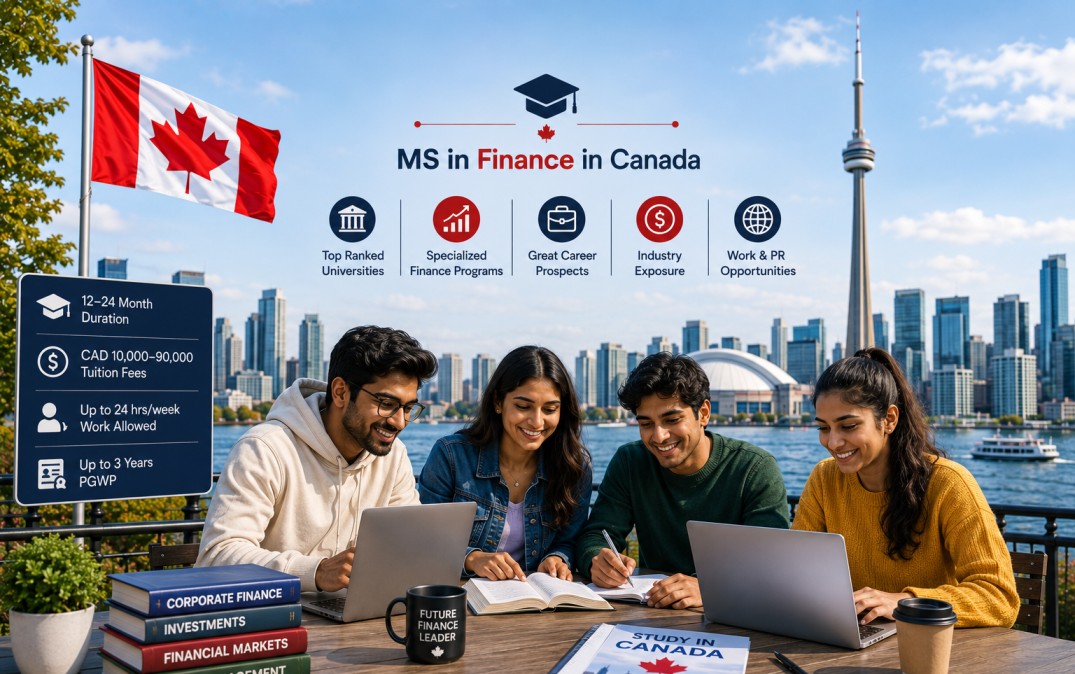
MS in Finance in Canada
Table of Contents
- Why Study MS in Finance in Canada?
- Top Universities for MS in Finance in Canada
- Eligibility Requirements for MS in Finance in Canada
- Cost of Studying MS in Finance in Canada
- Cost of Living for Finance Students in Canada
- Scholarships for MS in Finance in Canada
- Intakes for MS in Finance in Canada
- Admission Process for MS in Finance in Canada
- Student Visa Requirements for MS in Finance in Canada
- Work Opportunities While Studying MS in Finance in Canada
- Career Opportunities After MS in Finance in Canada
- Final Thoughts from Author
MS in Finance in Canada is a graduate-level degree offered as Master of Finance (MFin), Master of Management in Finance (MMF), or MSc in Finance by leading universities and business schools such as such as the University of Toronto (Rotman), McGill University, HEC Montréa.
These programs usually take 12-24 months and prepare students for careers in investment banking, corporate finance, financial analytics, risk management, fintech, consulting, and asset management.
Canada is home to globally recognised universities, offering industry-focused finance programs with strong employer connections.
Eligible graduates may also qualify for a Post-Graduation Work Permit (PGWP), making Canada an attractive destination for international students.
The table below gives a quick overview before you compare universities and costs:
Parameter | Details |
Top Ranked University | Toronto Rotman - Rank 17 |
Duration | 12-24 months |
Average Tuition Fees | CAD 10,000-90,000 (≈ INR 7 L-60 L) |
Living Cost | CAD 1,500-2,500/month (≈ INR 1 L-2 L) |
Proof of Funds | CAD 22,895/year (≈ INR 15 L) |
English Requirement | IELTS 6.5-7.0+ / TOEFL 92-100+ |
Work While Studying | Up to 24 hours/week off campus |
PGWP | Master’s graduates may get up to 3 years |
Salary Range | CAD 65,000-110,000/year (≈ INR 44 L-74 L) |
Why Study MS in Finance in Canada?
MS in Finance is a good option for students who want strong finance education, practical learning, and access to Canada’s banking, investment, fintech, insurance, and consulting sectors.
Major financial hubs such as Toronto, Montreal, Vancouver, Calgary, and Edmonton offer career opportunities across finance and business roles.
Canada is also attractive because eligible master’s graduates may qualify for a Post-Graduation Work Permit (PGWP) after completing their studies.
IRCC states that master’s degree graduates may qualify for a 3-year PGWP, even if the program is less than two years, provided they meet the required conditions.
Key reasons to choose this course include:
Strong demand for finance, analytics, risk, and investment roles.
Globally ranked business schools and finance programs.
Practical curriculum with case studies, projects, and internships.
Canada’s finance sector is connected to banking, insurance, fintech, and consulting.
Students can work up to 24 hours per week off campus during regular academic terms.
Note: If your goal is long-term work experience in Canada, choose a PGWP-eligible public university and check visa rules before applying.
Top Universities for MS in Finance in Canada
Top universities in Canada for MS in Finance offer professional, research-based, and quantitative finance programs for different career goals.
Students can choose programs focused on investment management, financial analytics, corporate finance, risk management, or fintech.
The table below show leading Canada universities for MS in Finance:
University / Business School | QS Business Master’s Rankings 2026: Finance | Tuition Fees (Approx.) |
University of Toronto Rotman School of Management | 17 | CAD 74,200 (≈ INR 50 L) |
McGill University Desautels Faculty of Management | =24 | CAD 59,500 (≈ INR 40 L) |
HEC Montréal | 101–110 | CAD 31,300 (≈ INR 21 L) |
University of Alberta School of Business | 111–120 | CAD 53,700 (≈ INR 36 L) |
McMaster University DeGroote School of Business | 131–140 | CAD 54,000 (≈ INR 36 L) |
Concordia University John Molson School of Business | 131–140 | CAD 39,700 (≈ INR 27 L) |
University of Manitoba Asper School of Business | 151–200 | CAD 18,600 (≈ INR 12 L) |
Core Subjects in MS in Finance in Canada
Core subjects in MS in Finance are designed to build strong analytical, technical, and decision-making skills. Most programs combine finance theory with practical modelling and market-based learning.
Common subjects include:
Corporate Finance
Investment Analysis
Financial Modelling
Derivatives
Fixed Income
Portfolio Management
Financial Accounting
Risk Management
Econometrics
Quantitative Finance
Mergers and Acquisitions
Fintech and Data Analytics
Popular Specializations in MS in Finance in Canada
Specialisations in MS in Finance in Canada help students build expertise in specific areas of finance and prepare for different career paths.
Canada's finance sector offers strong opportunities in banking, investment management, risk management, financial analytics, fintech, wealth management, and corporate finance.
Choosing the right specialisation can help students align their degree with their long-term career goals.
The table below lists popular options:
Specialization | Best For |
Financial Analytics | Data-driven finance roles |
Investment Management | Portfolio and asset management |
Risk Management | Banking, insurance, compliance |
Corporate Finance | Treasury, valuation, M&A |
Fintech | Digital banking and financial technology |
Sustainable Finance | ESG investing and climate finance |
Quantitative Finance | Modelling, trading, derivatives |
Eligibility Requirements for MS in Finance in Canada
To apply for MS in Finance, students usually need a bachelor’s degree in finance, business, economics, mathematics, statistics, engineering, or another quantitative field.
Many universities prefer a strong GPA, GMAT or GRE scores, English proficiency, and relevant work experience.
Some professional programs prefer applicants with 1-2 years of work experience, while pre-experience finance programs may accept fresh graduates.
The table below summarises common eligibility requirements:
Requirement | Expected Criteria |
Bachelor’s Degree | 3-4 year recognised degree |
Preferred Background | Finance, business, economics, STEM |
GPA | Around 3.0/4.0 or higher |
GMAT/GRE | Required or recommended by many programs |
English Test | IELTS / TOEFL / PTE |
Work Experience | 0-2 years depending on program |
Documents | SOP, CV, LORs, transcripts |
English Language Requirements for MS in Finance in Canada
Students applying for an MS in Finance usually need to prove English language proficiency through IELTS, TOEFL, PTE, or another accepted test if their previous education was not completed in English.
The table below shows common score ranges:
Test | Common Requirement |
IELTS Academic | 6.5-7.0+ |
TOEFL iBT | 92-100+ |
PTE Academic | 60-68+ |
Duolingo | Accepted by selected universities |
Cost of Studying MS in Finance in Canada
The cost of studying MS in Finance depends on the university, city, program format, and whether it is a research-based or professional business school program.
Public universities generally have lower tuition fees than some specialised business schools, while additional costs such as study trips, health insurance, and student fees may apply depending on the program.
Use the table below for a broad cost estimate:
Expense Type | CAD Cost | INR Equivalent |
Tuition Fees | CAD 10,000-90,000 | ≈ INR 7 L-60 L |
Living Cost / Year | CAD 18,000-30,000 | ≈ INR 12 L-20 L |
Study Permit Living Funds | CAD 22,895 | ≈ INR 15 L |
Application Fees | CAD 100-250 | ≈ INR 7,000-17,000 |
Books and Supplies | CAD 1,000-2,000 | ≈ INR 1 L |
Cost of Living for Finance Students in Canada
Finance students in Canada should budget carefully because major finance cities like Toronto and Vancouver can be expensive.
Montreal, Edmonton, Calgary, Hamilton, and Waterloo may be more manageable depending on rent and lifestyle.
The table below shows an estimated monthly budget:
Expense | Monthly Cost | INR Equivalent |
Shared Rent | CAD 700-1,500 | ≈ INR 47,000-1 L |
Food and Groceries | CAD 250-450 | ≈ INR 17,000-30,000 |
Transport | CAD 100-160 | ≈ INR 7,000-11,000 |
Utilities and Internet | CAD 150-250 | ≈ INR 10,000-17,000 |
Personal Expenses | CAD 200-400 | ≈ INR 13,000-27,000 |
Scholarships for MS in Finance in Canada
Scholarships for MS in Finance in Canada are usually offered by universities, business schools, provincial bodies, and external organisations.
Many business schools automatically consider admitted students for merit-based awards, while some awards require a separate application.
The table below lists common scholarship options:
Scholarship / Award | Benefit | Notes |
Rotman Entrance Awards | Varies | Merit-based |
McGill MMF Scholarships | Varies | Merit-based awards |
McCall MacBain Scholarship | Tuition + living support | Highly competitive |
UBC Sauder Awards | Varies | Program-specific |
Ontario Graduate Scholarship | CAD 5,000 (≈ INR 3 L)/term | Ontario universities |
FINCAD Women in Finance | External award | For eligible women in finance |
Intakes for MS in Finance in Canada
Most MS in Finance programs begin in the Fall Intake. Some universities may offer Winter or Summer intakes, but specialised finance master’s programs often have one main intake each year.
Applications usually open several months in advance and may follow multiple admission rounds.
Students should apply early to allow enough time for admission, scholarships, study permit processing, and financial planning.
The table below explains the common intake pattern:
Intake | Availability | Best Time to Apply |
Fall Intake | Most common | August - October |
Winter Intake | Limited | January |
Summer Intake | Rare / selected programs | May |
Admission Process for MS in Finance in Canada
The admission process for MS in Finance in Canada is usually completed through the university’s official application portal.
Some universities may also ask for a video interview, written essays, GMAT/GRE scores (where applicable), or additional program-specific requirements as part of the selection process.
Follow these steps:
Shortlist universities and finance programs.
Check eligibility, tuition, ranking, and PGWP eligibility.
Prepare IELTS/TOEFL and GMAT/GRE if required.
Arrange transcripts, CV, SOP, and LORs.
Apply through the official university portal.
Complete interview or video assessment if invited.
Receive admission offer.
Pay deposit if required.
Arrange funds and apply for study permit.
Plan accommodation, travel, and arrival.
Student Visa Requirements for MS in Finance in Canada
To study MS in Finance, students generally need a Canada Study Permit. Applicants must have a Letter of Acceptance, proof of sufficient funds, valid identity documents, and the required academic records.
Students should also be prepared to show that they can cover tuition fees and living expenses, along with any other documents requested by Immigration, Refugees and Citizenship Canada (IRCC).
The table below lists key study permit requirements.
Requirement | Details |
Letter of Acceptance | From a Designated Learning Institution (DLI) |
Proof of Funds | Tuition + CAD 22,895 (≈ INR 15 L) living funds |
PAL/TAL | Exempt for eligible public master’s programs |
Passport | Valid passport |
SOP / Study Plan | Explains academic and career intent |
Medical Exam | If required |
Biometrics | Required for most applicants |
English Scores | As required by university |
Note: From January 1, 2026, IRCC states that students applying to degree-granting master's or doctoral programs at public DLIs are exempt from the Provincial Attestation Letter (PAL) requirement.
Work Opportunities While Studying MS in Finance in Canada
Students pursuing MS in Finance in Canada can gain work experience through part-time jobs, internships, co-op placements, research assistantships, and networking projects.
Finance students often look for roles in banks, fintech firms, accounting firms, investment companies, and consulting firms.
IRCC allows eligible international students to work up to 24 hours per week off campus during regular terms and unlimited hours during scheduled academic breaks.
The table below explains work options:
Work Option | Availability |
Off-campus work | Up to 24 hours/week |
Scheduled breaks | Full-time allowed |
Internships | Program-dependent |
Co-op / placement | Depends on curriculum |
On-campus work | Allowed if eligible |
PGWP after graduation | Up to 3 years for eligible master’s graduates |
Career Opportunities After MS in Finance in Canada
An MS in Finance can open career opportunities in investment banking, financial analysis, risk management, corporate finance, consulting, portfolio management, fintech, and financial planning.
Toronto is Canada's leading financial Centre, while cities such as Montreal, Vancouver, Calgary, and Edmonton also offer opportunities across banking, insurance, asset management, energy finance, and consulting.
Career opportunities and salaries vary based on the role, employer, city, skills, and previous experience.
Many graduates find opportunities with major banks, consulting firms, insurance companies, pension funds, and growing fintech organisations.
The table below shows common salary ranges:
Job Role | Annual Salary | INR Equivalent |
Financial Analyst | CAD 65,000-95,000 | ≈ INR 44 L-64 L |
Investment Banking Analyst | CAD 85,000-130,000 | ≈ INR 57 L-87 L |
Risk Analyst | CAD 70,000-105,000 | ≈ INR 47 L-70 L |
Portfolio Analyst | CAD 75,000-120,000 | ≈ INR 50 L-81 L |
Financial Controller | CAD 90,000-140,000 | ≈ INR 60 L-94 L |
Source: Glassdoor
Final Thoughts from Author
MS in Finance in Canada is a strong choice if you want a finance-focused master’s degree with good career and work permit options.
But don’t choose a university only because of ranking. Check tuition, city cost, internship access, GMAT needs, work experience requirement, and PGWP eligibility.
If your budget is tight, compare research-based MSc options with professional MFin or MMF programs because the fee gap can be large.
Planning to pursue MS in Finance in Canada? Book a free 1:1 counselling session with our study abroad experts for personalised guidance.
Also Read:
Masters in Hamilton
Masters in Waterloo
Masters in Edmonton
Masters in Calgary