Masters in Waterloo
Table of Contents
- Why Study Masters in Waterloo?
- Top Courses to Study Masters in Waterloo
- Eligibility and Admission Requirements for Masters in Waterloo
- Cost of Masters in Waterloo
- Top Scholarships for Masters in Waterloo
- How to Apply for Masters in Waterloo
- Student Visa Requirements for a Masters in Waterloo
- Job Opportunities in Canada After a Masters in Waterloo
- Author's POV
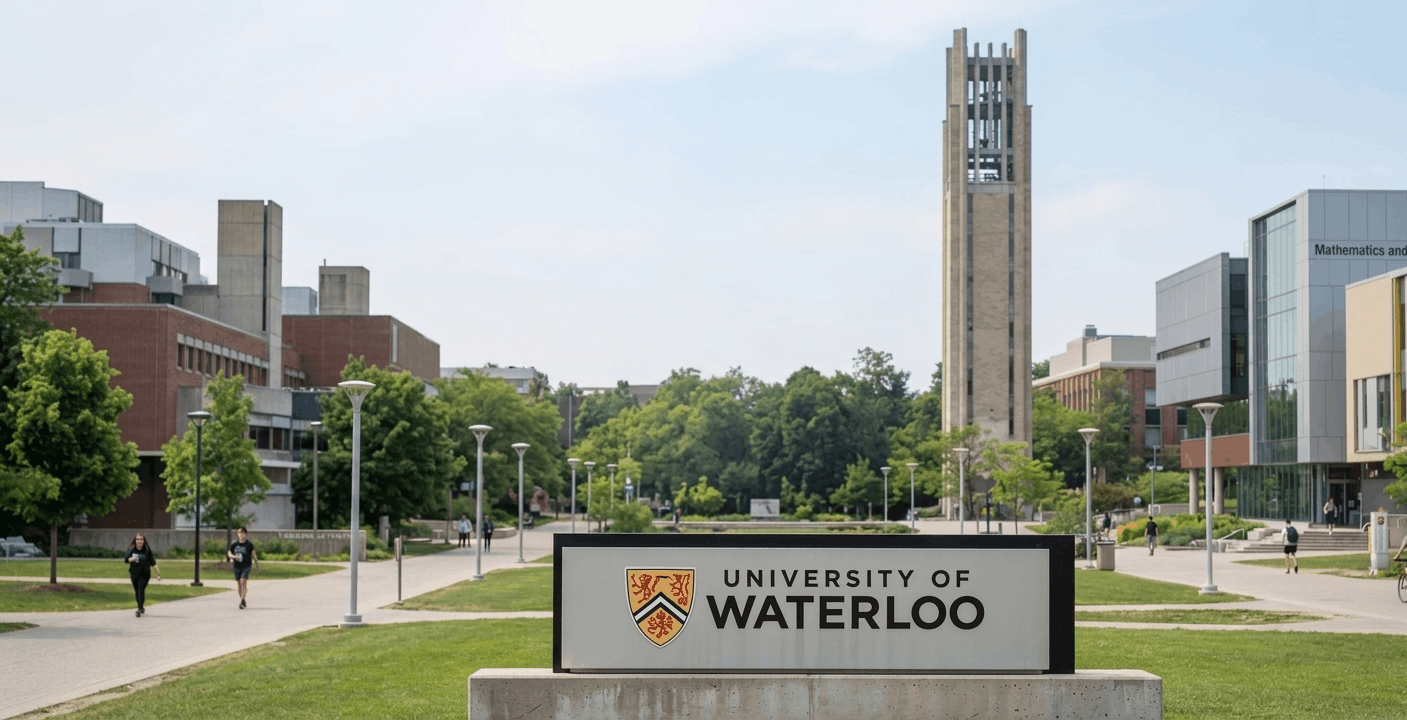
Planning a Masters in Waterloo gives international students access to one of Canada's most respected education destinations, led by the globally recognised University of Waterloo. Home to more than 100 master's programmes across engineering, computer science, business, health, mathematics, and environmental sciences, the university is known for combining academic excellence with industry-focused learning. Its strong research ecosystem, world-famous co-op model, and close partnerships with leading employers make Waterloo an attractive destination for students looking to build successful careers in Canada. Whether you choose a research-based or coursework master's, studying in Waterloo offers outstanding academic quality, excellent graduate employability, and strong post-study work opportunities.
Key Highlights of Masters in Waterloo:
Key Highlights | Details |
University | University of Waterloo |
QS World Ranking 2027 | #113 globally |
Course Duration | 12 to 24 months postgraduate |
Popular Fields | Computer Science, Electrical and Computer Engineering, Data Science, Pharmacy, Actuarial Science |
Tuition Fees | CAD 23,088–49,716/year (approx. INR 14.7L–31.7L) |
Living Expenses | Approx. CAD 43,200/year (approx. INR 27.5L) |
Post-Study Work Option | Post-Graduation Work Permit (PGWP) up to 3 years |
Signature Programme | World's largest co-op education system |
Why Study Masters in Waterloo?
Beyond a single ranking number, Waterloo offers international students a genuinely unusual combination: a globally respected engineering and computer science reputation, paired with the world's largest co-op programme, built directly into most graduate degrees rather than offered as an optional extra.
1. The World's Largest Co-op System: Waterloo runs the largest co-operative education programme on the planet, placing students into paid, degree-relevant work terms with employers ranging from local startups to Google and Amazon.
2. A Direct Pipeline Into Canada's Tech Corridor: The Kitchener-Waterloo region has earned the nickname "Silicon Valley North," home to hundreds of startups and established tech firms actively recruiting from Waterloo's graduate cohorts each term.
3. Globally Recognised Computer Science and Engineering: Waterloo's computer science and engineering programmes consistently rank among the strongest in Canada, with graduates recruited directly by major global tech employers.
4. Genuine Research Depth Beyond Tech: Waterloo also maintains strong graduate programmes in pharmacy, actuarial science, data science, and public health, giving the university a broader academic base than its tech reputation alone suggests.
5. A Lower Cost City Than Toronto: Waterloo's cost of living sits meaningfully below Toronto's, giving graduate students more financial breathing room during their studies and their post-study job search.
6. Post-Study Work Access: Graduates qualify for Canada's Post-Graduation Work Permit, giving up to three years of open work authorisation to build Canadian experience.
Top Courses to Study Masters in Waterloo
The University of Waterloo structures its graduate tuition selectively by program type rather than applying a single, flat institutional rate. Research-based programs (which often include institutional funding packages), professional course-based paths (MEng), and highly specialized professional fields like data science are billed under completely different structures.
Core Graduate Program Pricing:
1. Master of Mathematics / MSc in Computer Science
Waterloo's Computer Science track is delivered as a traditional, research-oriented thesis program. Because it is classified under the Graduate Research Masterstier, admitted international students are highly shielded by automatic funding packages, research assistantships, and graduate awards.
Official Tuition Rate: CAD 7,696 per term (approx. INR 4,88,690 per term)
Approx. Annual Tuition (3 Terms): CAD 23,088 (approx. INR 14,66,090 per year)
2. Master of Engineering (MEng) in Electrical and Computer Engineering
The MEng in Electrical and Computer Engineering is a professional, coursework-only path designed for rapid industry placement. Because it bypasses the research thesis layout, it does not carry research funding and is priced higher than standard research programs.
Official Tuition Rate: CAD 16,572 per term (approx. INR 10,52,320 per term)
Approx. Annual Tuition (3 Terms): CAD 49,716 (approx. INR 31,56,970 per year)
3. Master of Pharmacy (MPharm) Advanced Pharmacy Practice
This professional, clinical track focuses on advanced pharmacotherapy and regional clinical rotations. It is a highly specialized program distinct from the university's entry-level professional PharmD.
Official Tuition Rate: CAD 12,693 per term (approx. INR 8,05,990 per term)
Approx. Annual Tuition (3 Terms): CAD 38,079 (approx. INR 24,17,970 per year)
4. Master of Data Science and Artificial Intelligence (MDSAI)
The MDSAI is an intensive, professional program featuring a mandatory co-op work term. The academic fee structure is calculated on a per-course-unit basis rather than a flat terminal charge.
Official Tuition Rate: CAD 6,210 per course unit (approx. INR 3,94,330 per course)
Typical Full-Time Semester (3 Courses): CAD 18,630 per term (approx. INR 11,82,990 per term)
Typical Year (Non-co-op study terms): CAD 37,260 (approx. INR 23,65,990 per year)
Other High-Demand Specialized Programs
If your goals fall outside of computing or traditional engineering, Waterloo offers several targeted professional programs designed to feed directly into the Canadian financial, accounting, and healthcare sectors:
Program Title | Official Tuition per Term (CAD) | Approximate Cost per Term (INR) |
Master of Accounting (MAcc) | CAD 25,136 / term | INR 15,96,130 / term |
Master of Actuarial Science (MActSc) | CAD 18,351 / term | INR 11,65,280 / term |
Master of Public Health (MPH) | CAD 12,464 / term | INR 7,91,460 / term |
Master of Quantitative Finance (MQF) | CAD 9,052 / term | INR 5,74,800 / term |
Co-op Term Credit: If you are enrolled in a co-op stream, you do not pay tuition fees during your active work terms. You only pay a minor administrative co-op fee of CAD 817 (approx. INR 51,880), during which you can realistically earn between CAD 8,400 and CAD 18,000 (approx. INR 5.33 Lakh to INR 11.43 Lakh) over the 4-month placement.
Eligibility and Admission Requirements for Masters in Waterloo
Admission requirements for a Masters in Waterloo vary meaningfully by programme, since a research-based Computer Science masters is evaluated quite differently from a professional MEng or MPharm route.
Academic Requirements
Waterloo generally expects a four-year bachelor's degree with a strong academic standing, though the exact minimum shifts depending on faculty and programme competitiveness.
Programme Type | Minimum Academic Requirement | Key Notes |
Research Masters(MSc, Math) | Minimum 75% or equivalent in a relevant bachelor's degree | GRE scores may be requested for competitive Computer Science applicants |
Professional Masters(MEng, MDSAI) | Minimum 75% or equivalent | Strong quantitative or engineering background expected |
English Language Requirements
International applicants whose first language isn't English must submit an approved test score, and Waterloo's requirements are fairly consistent across most graduate programmes.
IELTS Academic: minimum 6.5 overall, generally accepted across most graduate programmes
TOEFL iBT: minimum 80, the standard benchmark used by Waterloo's admissions committees
Some professional programmes may set slightly higher thresholds, so confirming directly on your specific programme page is worth doing before applying
Cost of Masters in Waterloo
Tuition for a Masters in Waterloo genuinely varies by programme type, and building a realistic budget means factoring in this fee alongside living costs in the Kitchener-Waterloo region.
Tuition Fees Summary
Programme | Approx. Annual Tuition (CAD) | Approx. Annual Tuition (INR) |
Research Masters(Computer Science, Mathematics) | CAD 23,088 | INR 14.7 lakh |
MEng (Electrical and Computer Engineering) | CAD 49,716 | INR 31.7 lakh |
MDSAI (Data Science and AI, per course) | CAD 6,210/course | INR 3.96 lakh/course |
MPharm (Advanced Pharmacy Practice, per term) | CAD 12,693/term | INR 8.1 lakh/term |
Cost of Living for Masters in Waterloo
While Waterloo is significantly more affordable than metropolitan giant Toronto, international masters students must budget carefully for housing and living overheads. A single student should budget between CAD 2,121 and CAD 3,071 per month to cover both essential and day-to-day costs.
Expense Category | Monthly Cost (CAD) | Approximate Monthly Cost (INR) |
Shared Off-Campus Housing (including utilities) | CAD 950 – CAD 1,900 | INR 60,330 – INR 1,20,650 |
Food & Groceries | CAD 385 | INR 24,450 |
Books & Academic Supplies | CAD 247 | INR 15,680 |
Clothing & Personal Care | CAD 212 | INR 13,460 |
Phone & Internet Plans | CAD 106 | INR 6,730 |
Entertainment & Recreation | CAD 150 | INR 9,530 |
Laundry & Miscellaneous Transit | CAD 71 | INR 4,510 |
Total Monthly Budget | CAD 2,121 – CAD 3,071 | INR 1,34,690 – INR 1,95,010 |
Source: Numbeo
Top Scholarships for Masters in Waterloo
The University of Waterloo offers a wide range of funding opportunities for Masters students, but the support available depends on the type of programme you choose. Research-based Masters programmes often include funding packages made up of scholarships, teaching assistantships (TA), research assistantships (RA), and faculty grants.
In contrast, coursework-based professional programmes generally require students to arrange their own funding, although merit-based university scholarships, entrance awards, and external funding options can help reduce overall study costs.
Scholarship Name | Value (CAD & INR) | Selection & Eligibility Criteria |
International MastersAward of Excellence (IMAE) | CAD 2,500 per term (approx. INR 1,58,750/term) Up to 5 terms | • Automatic consideration during admission • Full-time research-based Masters student • Strong academic record (typically 80%+) • Available to eligible international students |
Ontario Graduate Scholarship (OGS) | CAD 15,000/year (approx. INR 9,52,500/year) Paid over 3 terms | • Separate scholarship application required • Open to research- and coursework-based Masters students • Must be registered at the University of Waterloo • Selection based on academic excellence |
President's Graduate Scholarship (PGS) | Up to CAD 5,000 (approx. INR 3,17,500) Paid over 3 terms | • No separate application • Awarded automatically by the university • Must have secured an OGS or Tri-Agency award • Based on outstanding academic performance |
Hira and Kamal Ahuja Graduate Engineering Award | Up to CAD 6,000 (approx. INR 3,81,000) One-time award | • Faculty nomination required • Full-time Engineering Masters or PhD student • Demonstrated financial need • Strong academic standing |
University of Waterloo Graduate Scholarship | Varies by department (Typically up to CAD 10,000/year / approx. INR 6,35,000/year) | • Automatic departmental assessment • Outstanding academic achievement • Strong research potential • Final nomination made by the admitting department |
How to Apply for Masters in Waterloo
Applying for a Masters in Waterloo requires good organisation, since programme-specific requirements, English test scores, and financial documentation all need to come together before your deadline.
Step | What to Do |
Step 1: Shortlist Your Programme | Compare Computer Science, MEng ECE, MDSAI, MPharm, or other graduate programmes based on your academic background and career goals |
Step 2: Check Eligibility | Review academic grade requirements and English language score minimums for your specific programme |
Step 3: Prepare Language Tests | Sit IELTS or TOEFL well ahead of your application deadline |
Step 4: Compile Documents | Gather transcripts, statement of purpose, letters of recommendation, and CV |
Step 5: Submit Application | Apply through Waterloo's official graduate admissions portal and pay the application fee |
Step 6: Accept Offer | Confirm your place once admitted and pay any required deposit |
Step 7: Apply for Study Permit | Submit your Canadian Study Permit application via IRCC once you receive your offer letter |
Step 8: Arrange Pre-Departure | Book accommodation, organise health insurance, and prepare travel documents |
Intakes and Application Timeline for Masters in Waterloo
Waterloo runs three intakes across the year, September, January, and May, though availability and deadlines vary significantly by specific programme.
Intake | Programme Start | Application Timeline |
Fall Intake (Main) | September | Deadlines typically fall between January and February for most programmes |
Winter Intake | January | Deadlines typically fall around June of the prior year |
Spring Intake | May | Deadlines typically fall around October of the prior year |
Note: Since Waterloo's co-op placements are built directly into most programmes, checking your specific programme's application deadline early is genuinely important, deadlines vary widely by department and aren't standardised university-wide.
Student Visa Requirements for a Masters in Waterloo
International students targeting a graduate degree in the Waterloo region require a formal Study Permit layered with a Temporary Resident Visa (TRV) or Electronic Travel Authorization (eTA). Administered directly through Immigration, Refugees and Citizenship Canada (IRCC), this framework regulates your legal stay, academic boundaries, and local employment clearances.
How the Canadian Study Permit Process Works:
The process maps out across two distinct federal streams. The Student Direct Stream (SDS) offers accelerated priority processing for Indian applicants who meet upfront financial and language requirements. Alternatively, the Regular Non-SDS Stream accepts generic funding layouts but commands extended administrative evaluation timelines.
Eligibility Criteria:
Official Letter of Acceptance (LOA): Issued directly by a Designated Learning Institution (DLI) like the University of Waterloo.
Provincial Attestation Letter (PAL): A mandatory regional tracking clearance provided by Ontario, if required for your specific Masters category.
Guaranteed Investment Certificate (GIC): The core living allowance deposit opened with an approved Canadian financial institution.
Upfront Medical Exam: Cleared through an IRCC-approved panel physician.
Clean Police Clearance Certificate (PCC): Verifying zero disqualifying criminal history.
Financial Requirements:
The Canadian immigration framework enforces strict, updated cost-of-living baselines to protect incoming candidates. For the current intakes, the single-applicant living requirement outside Quebec sits firmly at CAD 22,895 per year (approx. ₹15.3 Lakh).
To satisfy federal parameters, your total demonstrable financial layout must cover:
Documents Required for the Canadian Study Permit
Valid international passport with clean biometric history.
Official Letter of Acceptance from your university registrar.
Verified GIC certificate showing a fully cleared CAD 22,895 deposit.
Official receipt proving payment of your full first-year university tuition.
Comprehensive Statement of Purpose (SOP) detailing your academic route, career alignment, and explicit ties ensuring your return to India.
Job Opportunities in Canada After a Masters in Waterloo
Completing a Masters in Waterloo puts you in one of Canada's strongest technology and innovation hubs. Home to the University of Waterloo, the city is known for its extensive co-op network and close connections with leading employers in technology, finance, engineering, and consulting. International students graduating from eligible full-time Masters programmes can also apply for a Post-Graduation Work Permit (PGWP) of up to three years, providing valuable time to gain Canadian work experience and build a long-term career.
The table below outlines the core functional paths, key national employers, and real-world starting salaries:
Core Job Profile | Major Canadian Employers & Recruiters | Average Salary (CAD/INR) |
Machine Learning Engineer | Vector Institute, Amazon Canada, Borealis AI, Apple Canada | CAD 95,000 – CAD 130,000 (INR 60.3 Lakh – INR 82.5 Lakh) |
Software Development Engineer | Google Canada, Shopify, Microsoft Canada, OpenText | CAD 95,000 – CAD 140,000 (INR 60.3 Lakh – INR 88.9 Lakh) |
Data Scientist | Sun Life Financial, RBC, TD Bank Group, Deloitte Canada | CAD 85,000 – CAD 115,000 (INR 53.9 Lakh – INR 73.0 Lakh) |
Hardware / Systems Engineer | Intel Canada, AMD, Blackberry, ecobee | CAD 82,000 – CAD 115,000 (INR 52.0 Lakh – INR 73.0 Lakh) |
Quantitative Financial Analyst | CPP Investments, Scotiabank, BMO Capital Markets, Manulife | CAD 80,000 – CAD 105,000 (INR 50.8 Lakh – INR 66.6 Lakh) |
Source: Glassdoor
Author's POV
Choosing a Masters in Waterloo is less about studying in Canada's biggest city and more about positioning yourself where education and industry work closely together. Waterloo has built its reputation on innovation, research, and employer partnerships rather than lifestyle alone. That makes it especially attractive for students planning careers in technology, engineering, artificial intelligence, or data science.
One factor worth considering is the difference between research and professional masters programmes. Research-based degrees are generally more affordable and often include funding opportunities, making them ideal for students interested in research or future doctoral studies. Professional programmes, while more expensive, are designed for quicker entry into industry with a practical, career-focused curriculum.
What makes Waterloo stand out is its employment ecosystem. The university's strong links with Canadian technology companies and startups help graduates transition into the workforce with confidence. If your long-term goal is building a career in Canada's innovation economy, Waterloo remains one of the country's strongest choices.
Planning to study Masters in Waterloo? Connect with our experts for personalised guidance on admissions, universities, scholarships, and study permits.