Masters in Instrumentation and Control Engineering in Canada in 2026
Table of Contents
- Why choose Masters in Instrumentation and Control Engineering in Canada?
- Top Colleges for Masters in Instrumentation and Control Engineering in Canada
- Year-wise Curriculum for Masters in Instrumentation and Control Engineering in Canada
- Eligibility Requirements for Masters in Instrumentation and Control Engineering in Canada
- Masters in Instrumentation and Control Engineering in Canada's Tuition Fees for International Students
- Semester Date & Academic calendar for Masters in Instrumentation and Control Engineering in Canada
- How to Apply for Masters in Instrumentation and Control Engineering in Canada
- Scholarships available for students pursuing Masters in Instrumentation and Control Engineering in Canada
- Cost of Living: Transportation, Groceries and Accommodation
- Career Opportunities After completing Masters in Instrumentation and Control Engineering in Canada
- Conclusion
For Indian students eyeing a dynamic future in 2026, pursuing a Masters in Instrumentation and Control Engineering in Canada offers a strategic pathway. Typically spanning 1 to 2 years, students can choose between a research-based Master of Science (MSc) or a course-based Master of Engineering (MEng).
While strictly named degrees are rare, world-class institutions like the University of Toronto offer this curriculum under broader departments, specializing in Systems Control. Average tuition costs around $30,000 CAD (₹2,056,200 INR) annually, making it a valuable investment.
Key Highlights:
This table gives a quick overview of the essential metrics and financial values for this master's program.
Aspect | Major Details | Equivalent Value |
Program Duration | 1 to 2 years (MSc or MEng) | 12 to 24 months |
Average Tuition Fees | CAD 24,028 to CAD 45,000 (INR 1,646,879 to INR 3,084,300) per year | Varies by university ranking |
Average Living Cost | Minimum CAD 20,635 (INR 1,414,323) per year | Required for student visa |
Top Hiring Sectors | Manufacturing, Oil & Gas, Tech | Automation, Mining, Energy |
Average Starting Salary | CAD 106,871 (INR 7,324,938) annually | Based on 2026 industry data |
Why choose Masters in Instrumentation and Control Engineering in Canada?
Studying instrumentation and control here puts you right inside a booming tech market. Canada constantly needs automation professionals for its energy and manufacturing industries, meaning you won't struggle to find good work after you finish your classes.
Massive Industry Demand: With the shift toward Industry 4.0, Canadian companies are rapidly upgrading to smart factories and automated systems, creating thousands of job openings for control engineers.
Post-Graduation Work Permit (PGWP): Canada makes it incredibly easy to stay and work after your studies. The PGWP lets you build international work experience that can directly lead to permanent residency.
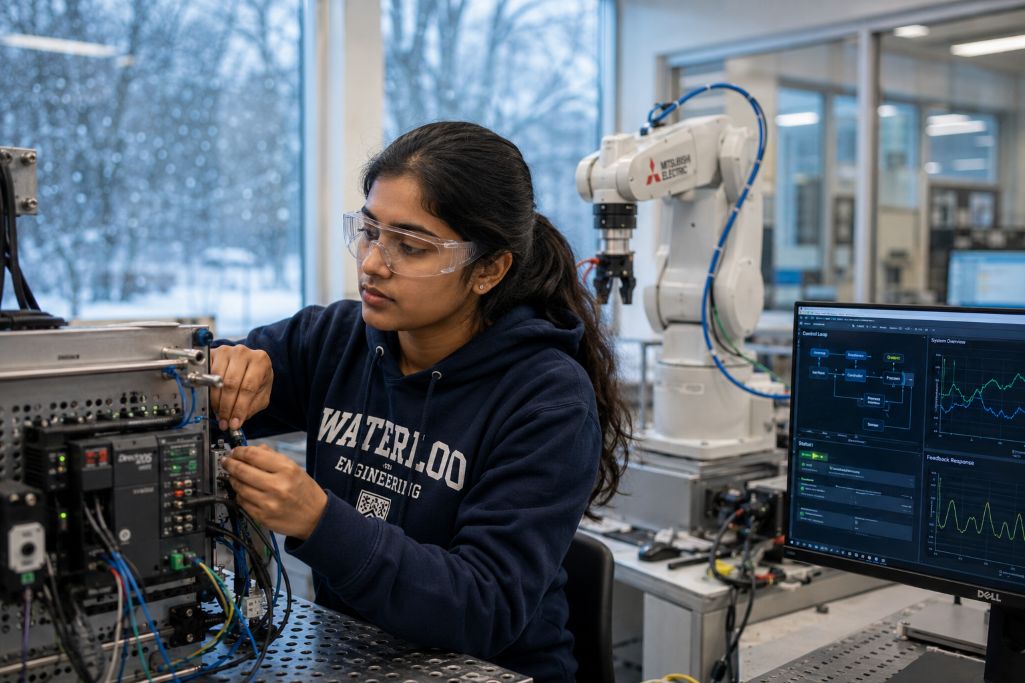
Cutting-Edge Lab Access: Universities here invest millions into state-of-the-art simulation labs. You get to practice on real Distributed Control Systems (DCS) and Programmable Logic Controllers (PLCs) used by actual companies.
High Salary Potential: Because this is a highly specialized skill, compensation is excellent. According to recent Indeed data, average salaries sit comfortably over CAD 100,000 (INR 6,854,000) for trained engineers.
Global Degree Recognition: A Canadian engineering master's degree is respected worldwide. You can easily take your credentials to the US, Europe, or back to India without any issues.
Top Colleges for Masters in Instrumentation and Control Engineering in Canada
Canada features amazing public universities with very strong engineering faculties. These schools have great ties with local industries, meaning you often get the chance to work on actual company projects while studying.
This table showcases the top Canadian universities based on global engineering rankings.
University | QS World Rank (2026) | Course Offered / Specialization |
University of Toronto | #21 | MEng in Electrical & Computer Eng. (Systems Control) |
University of British Columbia | #34 | MEng in Mechatronics and Automation |
McMaster University | #173 | MSc in Control and Automation |
University of Alberta | #111 | MSc in Process Control |
Western University | #114 | MEng in Electrical and Computer Engineering |
Year-wise Curriculum for Masters in Instrumentation and Control Engineering in Canada
The coursework is heavily structured to take you from basic systems math to building complex, automated robotic setups. You spend a lot of time running simulations and testing out algorithms in modern computer labs.
In recent years, universities have also integrated machine learning and AI into the curriculum, teaching you how to build self-optimizing factory processes. You will work with industry-standard software like MATLAB, LabVIEW, and advanced SCADA systems throughout your terms.
Year 1 Curriculum
Your first year is all about mastering the core math and theoretical concepts behind electronic systems.
Here is a breakdown of the core modules you study in your first year.
Module Category | Key Topics Covered | Academic & Practical Focus |
Core Systems | Advanced Control Theory, Digital Signals | Understanding dynamic systems and complex signals. |
Measurement | Industrial Sensors, Transmitters | Learning to measure temperature, pressure, and flow. |
Computing | Programming for Instrumentation | Using software to gather and analyze industrial data. |
Year 2 Curriculum
The second year gets you out of the textbooks and into practical applications, heavy lab work, and your final thesis.
This table outlines the hands-on and advanced topics covered in your final year.
Module Category | Key Topics Covered | Academic & Practical Focus |
Advanced Automation | PLC Programming, SCADA Systems | Designing and operating complex industrial networks. |
AI Integration | Machine Learning in Control Systems | Making automated systems smarter and self-correcting. |
Final Project | Master’s Thesis, Capstone Design | Solving a real industry problem using control engineering. |
Eligibility Requirements for Masters in Instrumentation and Control Engineering in Canada
Getting accepted into a good program requires solid marks in your bachelor's degree. Admission teams look closely at your core math and physics grades, as well as your ability to communicate clearly in English.
Academic, Professional, and Language Benchmarks
Make sure your past academic records align with the entry rules set by the engineering departments.
The following table details the minimum benchmarks required for admission.
Requirement Type | Minimum Benchmark | Detailed Context |
Academic Background | B.E. / B.Tech in Electrical/Electronics | A solid GPA (usually 70% or higher) is heavily expected. |
Standardized Tests | GRE (Required by some top universities) | Strong quantitative scores boost your overall profile for MSc degrees. |
Language Proficiency | IELTS 6.5 or TOEFL 90+ | Essential for effective communication in classes and labs. |
Work Experience | 1 to 2 years (Recommended) | Proven hands-on experience with industrial automation or PLCs gives you an edge. |
Technical Skills | Familiarity with MATLAB, SCADA, or C++ | Coding and simulation skills make your application much stronger. |
Reference Letters | 2 to 3 LORs | Must be from professors or managers who can vouch for your technical work. |
Masters in Instrumentation and Control Engineering in Canada's Tuition Fees for International Students
Looking at the numbers early helps you plan your budget without stress. The average graduate tuition for international students sits around CAD 24,028 (INR 1,646,879) annually, though premium engineering programs often push past CAD 35,000 (INR 2,398,900). Your fees go directly toward your classes, software licenses, and access to massive hardware labs.
Tuition fees at different colleges
Your final bill really depends on the province and the ranking of your chosen school.
This table details the updated annual tuition fees at leading Canadian engineering universities.
University | Annual Tuition Fees (CAD) | Annual Tuition Fees (INR) |
University of Toronto | CAD 40,467 | INR 2,773,608 |
University of British Columbia | CAD 35,000 | INR 2,398,900 |
McMaster University | CAD 43,000 | INR 2,947,220 |
Western University | CAD 38,000 | INR 2,604,520 |
University of Alberta | CAD 28,000 | INR 1,919,120 |
Semester Date & Academic calendar for Masters in Instrumentation and Control Engineering in Canada
Canadian colleges run on a standard schedule, with the biggest wave of students starting in the Fall. It is smart to track deadlines months in advance, because missing one can easily delay your education by an entire year.
Key Intake Timelines and Deadlines
Securing admission requires applying early, especially for the popular Fall intake which closes quickly.
This table highlights the critical application cycles and deadlines for international engineering applicants.
Academic Event | Expected Timeline | Key Action Required |
Fall Intake (Primary) | September Start | Apply between December and February of the previous year. |
Winter Intake (Secondary) | January Start | Apply between July and September (limited seats available). |
Spring Intake (Tertiary) | May Start | Apply by October or November (very few universities offer this). |
Scholarship Deadlines | Varies (Usually matches application) | Submit funding requests at the exact same time as your main application. |
Offer Acceptance | 2 to 4 weeks after receiving the offer | Pay the initial tuition deposit to lock in your seat and get the official letter. |
Visa Application | March to June (For Fall intake) | Apply for your Canadian study permit immediately after receiving an offer. |
How to Apply for Masters in Instrumentation and Control Engineering in Canada
Applying isn't just about sending in your grades. You need to show the professors that you actually like building and fixing systems. Use your statement of purpose to talk about coding projects, hardware you built, or any real-world internship experience you have.
Step-by-Step Application Guide
Follow this structured approach to make sure your application looks perfect to the reviewers.
The following table breaks down the essential steps to apply successfully.
Application Step | Action Required | Essential Details |
1. Shortlist & Prep | Pick universities and clear IELTS | Match your tech skills with the right faculty and get a 6.5+ band. |
2. Credential Verification | Get your degree evaluated | Use WES to ensure your Indian B.Tech matches Canadian educational standards. |
3. Gather Documents | Prepare Transcripts, SOP, and LORs | Highlight any hardware or software projects clearly in your SOP. |
4. Submit Application | Apply through university portals | Pay the application fee and double-check all uploaded PDFs. |
5. Interview Process | Clear technical or video interviews | Some research-based MSc programs require a quick chat with the supervisor. |
6. Accept Offer & Visa | Pay deposit and apply for study permit | Secure your seat and start the IRCC visa process immediately. |
Scholarships available for students pursuing Masters in Instrumentation and Control Engineering in Canada
Canadian universities and government bodies offer a variety of merit-based and need-based scholarships, fellowships, and assistantships designed to support graduate engineering students. By exploring both institution-specific awards and external funding opportunities, you can significantly alleviate your financial burden while focusing on your advanced research and studies.
Here is a look at five great scholarship options for international engineering students.
Scholarship Name | Eligibility Criteria | Reward Value (CAD / INR) |
Vanier Canada Graduate Scholarship | Exceptional academic and leadership skills | CAD 50,000 (INR 3,427,000) per year |
Ontario Graduate Scholarship | High academic merit at Ontario universities | CAD 15,000 (INR 1,028,100) per year |
UBC International Tuition Award | Enrolled in specific full-time master's programs | Up to CAD 3,200 (INR 219,328) per year |
UofT Engineering Fellowships | Top engineering applicants based on merit | Varies (Partial tuition offset) |
Alberta Innovates Graduate Scholarship | Research focusing on tech and innovation | Up to CAD 26,000 (INR 1,782,040) |
Cost of Living: Transportation, Groceries and Accommodation
You have to show the government that you can afford your daily life before they approve your study visa. According to the Immigration, Refugees and Citizenship Canada (IRCC) guidelines for 2026, a single student needs to show a minimum of CAD 20,635 (INR 1,414,323) strictly for living expenses, separate from whatever your tuition costs.
The following table outlines the estimated annual living expenses for a single student.
Expense Category | Annual Cost in CAD | Annual Cost in INR (approx.) |
Accommodation | CAD 10,000 – CAD 14,000 | INR 685,400 – INR 959,560 |
Meals / Groceries | CAD 4,000 – CAD 5,000 | INR 274,160 – INR 342,700 |
Transportation | CAD 1,200 – CAD 1,500 | INR 82,248 – INR 102,810 |
(Source: IRCC | Numbeo)
Career Opportunities After completing Masters in Instrumentation and Control Engineering in Canada
A master's degree in this specific field opens doors across mining, oil, manufacturing, and tech. With an average base salary of CAD 106,871 (INR 7,324,938) as reported by Indeed Canada, it is a very rewarding path. Major employers like Siemens, Suncor, Rockwell Automation, Hatch, and AMETEK are always looking for fresh talent.
This table provides a list of common job titles and their average starting salaries.
Target Job Role | Key Employers | Average Salary (CAD / INR) |
Instrumentation Engineer | Ausenco, AMETEK | CAD 106,871 (INR 7,324,938) |
Automation Engineer | Siemens, Rockwell Automation | CAD 95,000 (INR 6,511,300) |
Process Control Engineer | Suncor, Imperial Oil | CAD 110,000 (INR 7,539,400) |
PLC/SCADA Developer | Hatch, Eramosa Engineering | CAD 90,000 (INR 6,168,600) |
Robotics Engineer | Clearpath Robotics, Tech Firms | CAD 92,000 (INR 6,305,680) |
Senior Controls Engineer | Major Consulting Firms | CAD 120,668 (INR 8,270,584) |
Systems Integration Engineer | ABB, Honeywell | CAD 98,000 (INR 6,716,920) |
(Sources: Glassdoor)
Conclusion
Going for a Masters in Instrumentation and Control Engineering in Canada puts you in a great spot for the future. The classes do an excellent job of mixing deep math and theory with actual hands-on time in robotics and automation labs. You graduate with the exact skills that modern factories and tech companies are desperately searching for.
With average engineering salaries sitting near CAD 106,871 (INR 7,324,938), your hard work pays off really quickly. Get your transcripts together, prepare for your IELTS, and start applying so you can secure a seat for the 2026 academic year.
Ready to embark on your masters journey in Instrumentation and Control Engineering in Canada? Connect with our experts to know about concerned costs like tuition fees and cost of living, curriculum, scholarships, admissions, and career opportunities.