Masters of Forensic Science in Canada for Indian Students in 2026
Table of Contents
- Why choose Masters in Forensic Science in Canada
- Top colleges for Masters in Forensic Science in Canada
- Year-wise Curriculum for Masters in Forensic Science in Canada
- Eligibility Requirements for Masters in Forensic Science in Canada
- Masters in Forensic Science in Canada's Tuition Fees for International Students
- Semester Date & Academic calendar for Masters of Forensic Science in Canada
- How to Apply for Masters of Forensic Science in Canada
- Career Opportunities After completing Masters of Forensic Science in Canada
- Scholarships available for students pursuing Masters of Forensic Science in Canada
- Cost of Living: Transportation, Groceries & Accommodation
- Conclusion
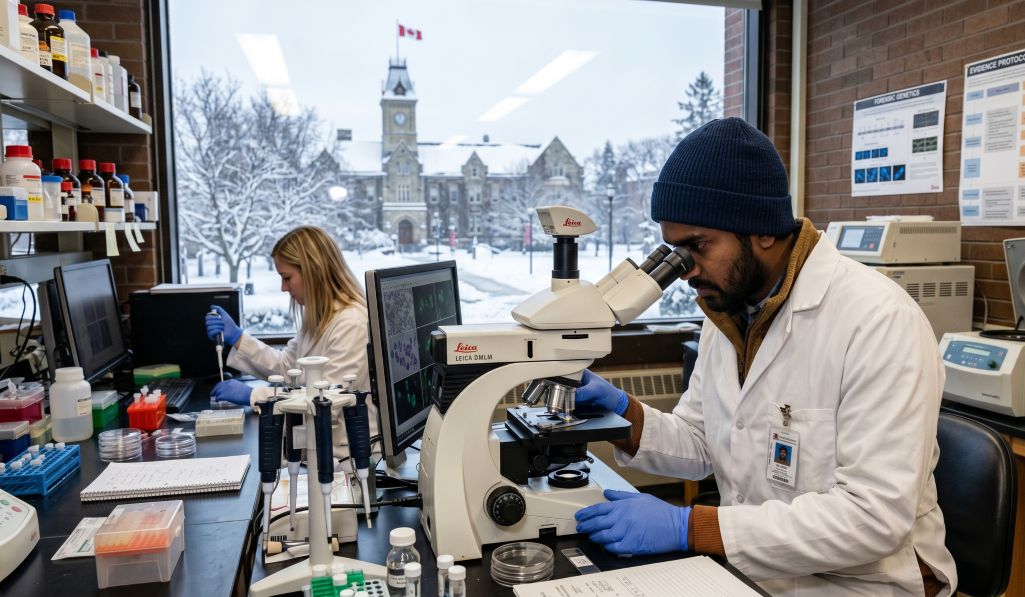
Masters of Forensic Science in Canada is an amazing opportunity for Indian students to seamlessly blend science with criminal justice. These dynamic programs typically take 1 to 2 years to complete and equip graduates with highly sought-after expertise in core specializations like DNA analysis, forensic toxicology, chemistry, and digital forensics.
For international students planning their educational investments for 2026, tuition costs generally range between $20,000 CAD (₹13,71,200) and $35,000 CAD (₹23,99,600) per year. With cutting-edge research facilities and global recognition, Canada stands out as a premier destination to launch a successful career in forensics.
Key Highlights:
The table below highlights the critical metrics and values associated with pursuing this master's degree.
Aspect | Major Details | Context |
Program Duration | 12 to 24 months | Depends strictly on whether you choose course-based or research tracks. |
Average Tuition Fees | $20,000 CAD (₹1,371,200) to $35,000 CAD (₹2,399,600) per annum | Varies based on the university's location, prestige, and laboratory facilities. |
Average Living Cost | $15,000 CAD (₹1,028,400) to $19,000 CAD (₹1,302,640) per year | Living costs are higher in major urban centers like Toronto and Vancouver. |
Top Hiring Sectors | Law Enforcement, Private Labs, Cyber Agencies | Massive and continuous demand exists across both public and private sectors. |
Average Salary | $60,000 CAD (₹4,113,600) to $125,000 CAD (₹85,70,000) annually | Represents standard starting to mid-level pay scales across Canadian provinces. |
Why choose Masters in Forensic Science in Canada
Studying forensic science in Canada grants you direct access to advanced research labs and renowned crime-solving institutions. The comprehensive curriculum effortlessly bridges theoretical knowledge with intensive practical case studies, making you highly employable worldwide upon graduation.
Top-Tier Infrastructure: Gain hands-on experience in specialized university labs equipped with modern DNA sequencing, ballistic testing, and digital cyber-tracking tools.
Post-Graduation Work Permit (PGWP): Upon graduation, international students can secure a PGWP, allowing them to live and work anywhere in Canada for up to three full years.
High-Demand Job Market: There is a strong, continuous need for forensic experts across the Royal Canadian Mounted Police (RCMP), local police forces, and private cybersecurity firms.
Diverse Specializations: Programs allow you to focus on niche areas such as forensic pathology, digital forensics, toxicology, forensic odontology, or criminal psychology.
Safe and Multicultural Environment: Canada consistently ranks as one of the safest, most welcoming countries for international students, offering a high quality of life.
Global Degree Recognition: A Canadian master's degree carries immense international respect, simplifying your transition if you return to India or relocate globally.
Research-Driven Practice: Learn advanced, evidence-based methods for analyzing complex crime scenes, managing dynamic evidence chains, and preparing expert courtroom testimonies.
Elite Corporate Networks: Benefit from strong university partnerships with national security agencies, private financial fraud units, and established legal tech firms.
Top colleges for Masters in Forensic Science in Canada
Canada is home to prestigious, globally recognized institutions that excel in advanced medical, legal, and criminal sciences. These top-tier universities provide exceptional research backing, modern mock crime scene facilities, and unparalleled internship partnerships to ensure maximum practical readiness.
The following table showcases 10 top Canadian universities based strictly on the latest world rankings.
University | QS World Rank (2026) | Course Offered |
University of Toronto | #21 | BS/MS Pathways in Forensic Science |
McGill University | #30 | MSc in Psychiatry/Life Sciences (Forensic focus) |
University of British Columbia | #34 | MSc related to Pathology/Forensics |
University of Alberta | #111 | MSc in Laboratory Medicine and Pathology |
Western University | #114 | MSc in Pathology with Forensic Focus |
University of Calgary | #182 | Master's related to Medical/Biological Sciences |
McMaster University | #189 | MSc in Health and Science tracks |
Simon Fraser University | #318 | MA in Criminology / Forensic Studies |
Carleton University | #651 | MA in Psychology with Forensic Concentration |
University of Windsor | #801 | MSc in relevant science tracks |
Source: QS World University Rankings 2026
Year-wise Curriculum for Masters in Forensic Science in Canada
The curriculum is methodically designed to mold you into an independent, evidence-based scientific investigator. It progresses naturally from foundational legal and laboratory methodologies to mastering specialized analytical techniques, ultimately testing your skills during extensive real-world research projects.
Year 1 Curriculum
The first year establishes your core scientific knowledge and basic practical diagnostic abilities.
This table details the primary subjects and academic focus of your first-year modules.
Module Category | Key Topics Covered | Academic & Practical Focus |
Foundational Science | Crime Scene Investigation, Criminal Law | Grasping legal frameworks and initial evidence collection methods. |
Analytical Techniques | Forensic Toxicology, Trace Evidence | Learning to accurately detect and interpret chemicals and micro-materials. |
Behavioral Studies | Forensic Psychology, Criminology | Studying human behavior and profiling within the criminal justice system. |
Year 2 Curriculum
The second year shifts heavily into independent research, advanced specializations, and practical internships.
This table highlights the specialized subjects and practical hospital focus of your final year.
Module Category | Key Topics Covered | Academic & Practical Focus |
Advanced Technology | Digital Forensics, Advanced DNA Analysis | Applying complex scientific methods to solve difficult digital or biological cases. |
Practical Placements | Internships with Labs or Police Units | Gaining real-world experience under the supervision of active industry experts. |
Research Project | Master's Thesis, Independent Case Study | Contributing fresh, data-driven scientific findings to the global forensic field. |
Eligibility Requirements for Masters in Forensic Science in Canada
Securing admission into a Canadian master's program is competitive and demands a rigorous academic profile. Universities closely evaluate your undergraduate grades, documented laboratory exposure, and English communication abilities to guarantee accuracy and safety in scientific reporting.
Academic, Professional, and Language Benchmarks
Applicants must strictly meet the criteria outlined by university science faculties.
This table provides a concise breakdown of the minimum requirements for international applicants.
Requirement Type | Minimum Benchmark | Detailed Context |
Academic Background | Bachelor's in Biology, Chemistry, or Forensics | A four-year degree with a minimum GPA of 3.0 (around 70–75% minimum). |
Lab Experience | Not mandatory, but highly preferred | Documented practical exposure through university research or internships. |
Language Proficiency | IELTS 6.5 (No band below 6.0) | Exceptional English fluency is required for academic writing and reporting. |
Masters in Forensic Science in Canada's Tuition Fees for International Students
Proper financial planning is completely essential for a seamless and stress-free transition to studying abroad. Your tuition fees will cover your expert academic instruction, unlimited access to elite laboratory tools, and the complex logistical coordination of your practical internships.
Tuition fees at different colleges
The cost of education heavily fluctuates based on the university's prestige and location.
This table directly compares the accurate financial investment required at recognized Canadian institutions.
University | Annual Tuition Fees (CAD) | Annual Tuition Fees (INR) |
University of Toronto | $27,520 CAD | ₹1,886,771 |
University of British Columbia | $49,518 CAD | ₹3,394,954 |
Trent University | $30,758 CAD | ₹21,08,768 |
Laurentian University | $28,920 CAD | ₹1,982,755 |
Ontario Tech University | $20,124 CAD | ₹1,379,701 |
Western University | $16,995 CAD | ₹1,165,177 |
Carleton University | $15,033 CAD | ₹1,030,662 |
St. Mary's University | $13,847 CAD | ₹949,353 |
University of Windsor | $9,101 CAD | ₹623,964 |
Brock University | $6,725 CAD | ₹461,066 |
Semester Date & Academic calendar for Masters of Forensic Science in Canada
Canadian universities adhere closely to a traditional, cohort-based academic calendar, generally welcoming students during the primary autumn intake. Missing these strict application deadlines can severely delay your academic career, making proactive timeline management absolutely crucial.
Key Intake Timelines and Deadlines
Successfully securing a seat requires early preparation and strict adherence to university deadlines.
This table details the essential timelines you must follow for a seamless university application.
Academic Event | Expected Timeline | Key Action Required |
Fall Intake (Primary) | September Start | Submit your university applications between December and March early on. |
Winter Intake (Secondary) | January Start | Apply between June and September for programs offering a mid-year cycle. |
Visa Application | May to July | Apply for your Canadian study permit immediately after receiving your LOA. |
How to Apply for Masters of Forensic Science in Canada
The international application process requires demonstrating genuine academic brilliance alongside a deep commitment to scientific research. Admissions committees will rigorously review your statement of purpose and references to determine your specific professional mindset and readiness for corporate or field forensics.
Step-by-Step Application Guide
Follow this structured pathway to build an incredibly strong, competitive applicant profile.
This table breaks down your entire application timeline into six actionable phases.
Application Step | Action Required | Essential Details |
1. Shortlist Programs | Research courses and prerequisites | Evaluate whether your science degree meets the prerequisite credits. |
2. Language Certification | Book and clear your IELTS exam | Aim for an overall score of 6.5 or above with no band below 6.0. |
3. Document Compilation | Draft your SOP and request LORs | Highlight your mandatory lab hours and secure strong academic references. |
4. Application Submission | Apply via university direct links | Fill out portals accurately and pay specific institutional fees on time. |
5. Await Decision | Monitor portal and email notifications | Respond promptly to interview calls or requests for supplementary transcripts. |
6. Study Permit Processing | Pay tuition deposit and apply for visa | Secure your official Letter of Acceptance (LOA) to launch your visa file. |
Career Opportunities After completing Masters of Forensic Science in Canada
A Canadian forensic science degree transforms you into a highly sought-after professional across public law enforcement, corporate security networks, and legal systems. Graduates enter a robust, fast-paced job market featuring immense variety, strong starting wages, and excellent long-term career progression routes.
High-Demand Roles and Salary Ranges
Graduates can specialize in various high-demand clinical or laboratory fields with highly competitive salaries.
This table highlights specific job roles, key employers, and their corresponding salary ranges.
Target Job Role | Key Employers (Min 5) | Salary Range (CAD / INR) |
Forensic Psychologist | RCMP, Correctional Service Canada, CAMH, Provincial Courts, Private Clinics | $85,000 CAD – $125,000 CAD (₹5,827,600 – ₹8,570,000) |
Forensic Pathologist | Provincial Death Investigation Services, Local Hospitals, Health Canada, RCMP Labs, Universities | $150,000 CAD – $300,000 CAD (₹10,284,000 – ₹20,568,000) |
Digital Forensics Analyst | Deloitte, KPMG, RCMP Cybercrime Unit, Magnet Forensics, CSIS | $70,000 CAD – $95,000 CAD (₹4,799,200 – ₹6,513,200) |
Forensic Toxicologist | Centre of Forensic Sciences, RCMP, Dynacare, Maxxam Analytics, Health Canada | $65,000 CAD – $90,000 CAD (₹4,456,400 – ₹6,170,400) |
Crime Scene Investigator | Toronto Police Service, RCMP, Vancouver Police, OPP, Local Law Enforcement | $60,000 CAD – $85,000 CAD (₹4,113,600 – ₹5,827,600) |
Quality Assurance Specialist | Bureau Veritas, SGS Canada, LifeLabs, Health Canada, Pharmaceutical Firms | $50,000 CAD – $70,000 CAD (₹3,428,000 – ₹4,799,200) |
Source: Glassdoor
Scholarships available for students pursuing Masters of Forensic Science in Canada
The Canadian government and major universities provide numerous high-value scholarships to attract brilliant global talent. Securing financial backing effectively minimizes your heavy tuition costs while simultaneously adding highly respected prestige to your growing academic and professional portfolio.
Top International Scholarships
There are diverse funding opportunities specifically available for international science students.
This table details five distinct scholarships available to offset your educational expenses.
Scholarship Name | Eligibility Criteria | Coverage / Reward Value (CAD / INR) |
Vanier Canada Graduate Scholarships | Outstanding academic achievement and leadership for master's/doctoral students. | $50,000 CAD (₹3,428,000) per year |
Ontario Graduate Scholarship (OGS) | Minimum A- average in the last two years of study; valid study permit. | Up to $15,000 CAD (₹1,028,400) |
University of Waterloo International Funding | Open to full-time international students demonstrating strong academic records. | $2,500 CAD – $50,000 CAD (₹171,400 – ₹3,428,000) |
UBC International Leader of Tomorrow Award | Demonstrated academic merit and financial need for international students. | Varies based on calculated financial need |
Ritchie Jennings Memorial Scholarship | Full-time students with recommendations from professors; specific focus areas apply. | $1,321 CAD – $13,309 CAD (₹90,567 – ₹912,465) |
Source: Zollege Scholarship Data Portal
Cost of Living: Transportation, Groceries & Accommodation
Beyond your university tuition, managing daily, real-world living expenses is incredibly critical for success. Keeping a detailed budget ensures a smooth stay while pursuing your advanced academic goals in Canada.
Major Cost Heads
The following table accurately outlines the estimated annual living expenses for a single international student.
Expense Category | Annual Cost in CAD | Annual Cost in INR |
Accommodation | $8,000 CAD – $12,000 CAD | ₹5,48,480 – ₹8,22,720 |
Meals / Groceries | $3,500 CAD – $4,500 CAD | ₹239,960 – ₹3,08,520 |
Transportation | $1,000 CAD – $1,500 CAD | ₹68,560 – ₹102,840 |
Utilities & Internet | $1,000 CAD – $1,500 CAD | ₹68,560 – ₹102,840 |
Source: Numbeo
Conclusion
Masters in Forensic Science in Canada offers an unparalleled advantage for Indian students aiming to build a successful career in criminal investigation and scientific analysis. The country provides an excellent mix of highly ranked academic institutions, cutting-edge laboratory facilities, and a safe, multicultural environment. Programs uniquely balance intense theoretical instruction with essential hands-on training, preparing you for real-world challenges. By planning your finances carefully and adhering strictly to application deadlines, you can smoothly transition into a rewarding and highly respected global career starting in 2026.
Connect with our experts to get the right mentorship for your career in the field of Forensic Science in Canada.